
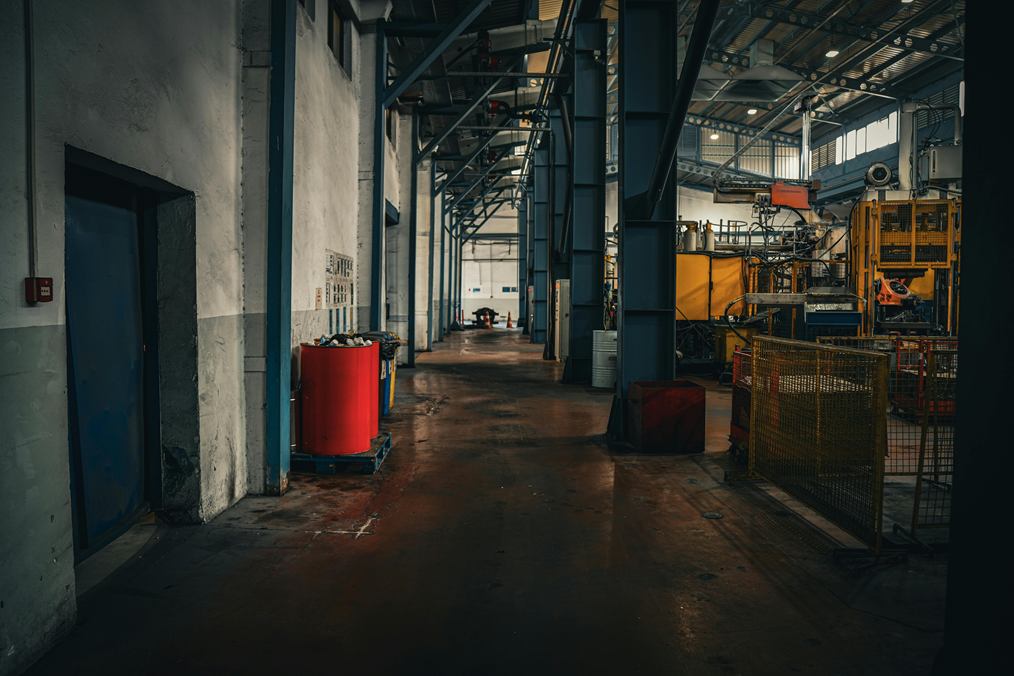

Floor access covers should be easy to install and operate, stand up to the heaviest anticipated loads, and provide the long-term durability that makes compliance simple. Choose carefully.
Start With the Actual Load, Not the Label
The term “heavy-duty” is not specific enough. Before you think about any product, work out the loads that will actually pass over that cover. That includes forklift axle weights, loaded pallet trucks, and the dynamic impact factor when vehicles cross at speed.
The FACTA classification system provides a method for doing this. Class D covers handle up to 400kN. This is suitable for most industrial warehouse traffic. Class E covers go to 600kN and are necessary for areas where HGVs or heavy plant equipment are present. EN 124 is the equivalent standard for covers that are part of trafficked floor slabs, often in applications where civil engineering loads prevail.
When in doubt, go up. Specifying a Class E cover in a Class D environment costs a tiny bit more. But if you specify a Class D cover in a Class E environment, it can split a frame or cause a collapse.
Ergonomics Are Part of the Specification
A cover rated for 600kN is useless if the maintenance team can’t safely open it. Any floor access cover weighing over 20kg should be equipped with mechanical lifting assistance, gas struts, hydraulic cylinders, or dampened spring systems that reduce the manual effort to a level one person can safely manage.
This isn’t just about comfort. Manual handling injuries are one of the most consistent sources of workplace injury claims, and a cover that requires two people with a crowbar to open is going to be avoided, wedged open, or forced in ways that damage the mechanism. The Surespan floor hatch range illustrates how modern engineering can deliver covers rated for heavy vehicular traffic while still opening with controlled, single-person effort through properly sized gas strut assistance.
Specify the counterbalance force to achieve an opening effort of no more than 25N at the handle. That’s achievable even on large, heavy covers with the right mechanism.
Match the Material to the Environment, Not the Budget
Material selection is the first place a lot of specs go wrong. The path of least resistance is a spec of galvanized steel. It’s low cost and structurally fine. For a dry warehouse, with no chemical exposure and typical cleaning, it’s not a bad choice.
But most hatches aren’t for dry warehouses. Chemical processing plants, food production, offshore environments, and pharmaceutical manufacturing all use aggressive washdowns, concentrated cleaning solutions, or direct chemical processing. Galvanized steel will corrode, warp, and fail in those environments. 316 stainless steel is a much more corrosion-resistant version of stainless that will hold up under the conditions that count.
Recessed covers are a separate case. If the hatch should be filled with surrounding floor finish, concrete, resin, or epoxy screed, the frame must be detailed and strong enough to take that additional mass and remain dimensionally stable. A cover deflecting under floor finish will crack the surrounding finish and create a trip hazard.
Don’t Treat Fall Protection as an Afterthought
When an access cover hinged at one side is opened, it becomes a hole in the ground. Obvious, but the safety response to it is often inadequate. Warning tape and verbal instruction are not engineering controls.
An access cover at the very least needs to be specified with a safety grid, a secondary mesh barrier that keeps the human out when the lid is off. For higher-risk applications, self-closing barriers or safety stay bars that lock the cover at 90 degrees are also available.
Slips, trips, and falls on the same level account for about 32% of all non-fatal workplace injuries (HSE). A significant number of these incidents relate to floor level changes, protruding frames, and surfaces of different materials that do not match the friction characteristics of the surrounding floor. Specify covers with a minimum Pendulum Test Value (PTV) of 36 on the wet pendulum scale – the threshold for “low slip risk” under the same conditions.
Separation, Sealing, and Compartmentation
In multi-storey industrial facilities, floor access hatches have a role far beyond ensuring a safe route across voids in floors and ceilings. They also perform a critical function as a continuous, load-bearing, fire-resistant barrier between building compartments. If any compartment wall or floor is breached for a stairwell, lift or plant room then that void must maintain a similar level of compartmentation to the wall or floor itself, and the access panel will be an integral part of that barrier.
Hatches are no different from stairs, walls, and floors regarding their key role in containing fire, smoke, extreme heat, noise pollution, and odorous or hazardous fumes. A well-designed hatch is solid, not hollow; has fully insulated construction, not single steel skin; and is fitted with dense, fire-rated, and preferably double acoustic seals, not lightweight rubber gaskets.
The fire integrity rating of the hatch should match that of the compartment wall or floor it is integrated within, often 60 or 120 minutes but occasionally 30 minutes for smaller buildings and plant rooms. Specify the performance requirement first, then find the product that meets it. A floor access cover is load-bearing infrastructure. It should be specified like one.