

Enterprise IT teams lose thousands of hours every year to manual asset tracking, misplaced hardware, and employee departure gaps that leave devices unrecovered. The right IT asset management software fixes that, and the 8 best IT asset management software for enterprise IT teams listed here cover the full range, from SaaS platforms to open-source tools and managed service options.
1. Workwize
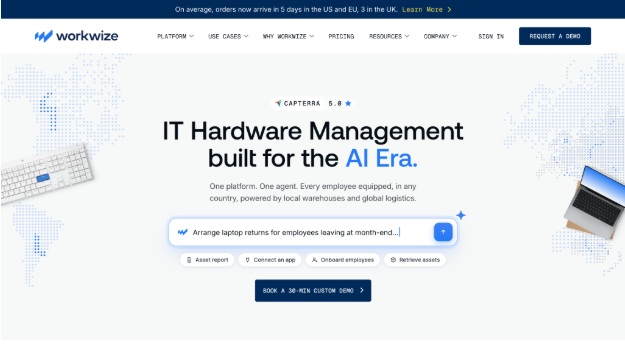
Workwize is a global IT asset lifecycle management platform built for distributed and enterprise teams that need to procure, deploy, track, retrieve, and dispose of hardware across many countries from a single system.
Where it fits: Teams managing hardware across 120 countries get HR system-triggered automation so new hire and employee departure processes don’t require manual handoffs. A new hire confirmed in BambooHR, ADP, or Okta automatically triggers device procurement and shipment from a local warehouse. At employee departure, courier pickup is initiated automatically, with customs handled – reported retrieval rates reach up to 98%. One central registry logs every assignment, transfer, wipe, and disposal, giving IT and Finance 100% chain-of-custody visibility without building it manually. The platform works with 80+ tools spanning HRIS, MDM (Jamf, Kandji, Microsoft Intune), and identity providers, with SSO, SCIM, and a public API available. Security credentials include ISO 27001 and SOC 2 Type II. Pricing is quote-based across three tiers; a 30-minute scoping demo maps the workflow before any commitment is made.
2. Asset Tiger
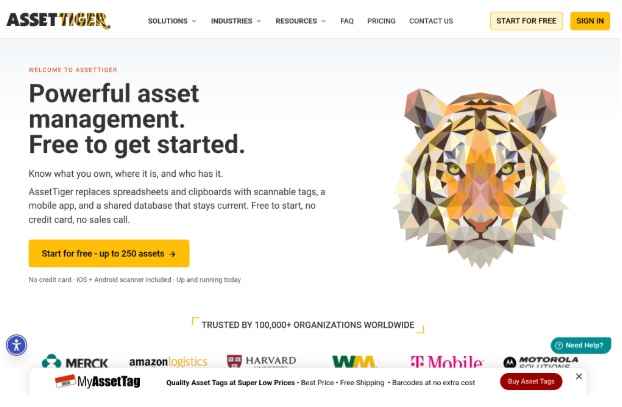
AssetTiger is an asset management platform built and operated by SmartSign, LLC – the team behind MyAssetTag.com – and designed to replace expensive, clunky tracking systems with something practical and affordable.
Where it fits: Small IT teams and multi-department organizations (schools, nonprofits, government offices, hospitals) that need barcode and QR code scanning, check-in/check-out custody logs, and maintenance and warranty alerts without paying per seat. AssetTiger’s pricing scales by asset count, not by user count, so the entire team is included at every plan level – from free up to 250,000 assets. It offers 80+ built-in report types covering depreciation, audit reconciliation, and contract expiries, and it’s rated 4.6 across 271 Capterra reviews with GetApp Category Leader recognition. Over 100,000 organizations use it.
Worth checking: AssetTiger’s strength is breadth of asset tracking, not deep automation of IT lifecycle workflows like automated employee departure or HRIS connection. Enterprises that need cross-border retrieval or MDM-event-triggered provisioning will find the platform more suited to general asset inventory than end-to-end IT lifecycle management.
3. SuperOps
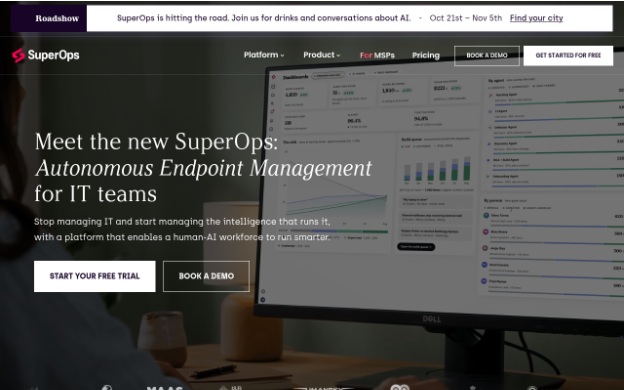
SuperOps is an AI-native unified IT operations platform founded in 2020 that serves both in-house IT teams (ITSuite) and managed service providers (MSPSuite) from a single architecture.
Where it fits: IT teams that want to consolidate multiple tools – RMM, MDM, helpdesk, ITAM, patch management, and PSA – into one system with a shared data layer. SuperOps’s Monica, a purpose-built agentic AI, moves routine tasks from automation to autonomous execution. The platform has raised $54.4M in funding (including a $25M Series C from March Capital in early 2025), operates across 104+ countries, and has 176 employees as of mid-2026. Plans start at $79 to $159 per user or per endpoint depending on tier, with a free trial available.
Worth checking: SuperOps is a strong fit for MSPs and tech-forward in-house teams, but organizations looking strictly for hardware lifecycle management – procurement logistics, cross-border retrieval, or ITAD – will find those workflows require pairing the platform with additional tools or services.
4. Anunta
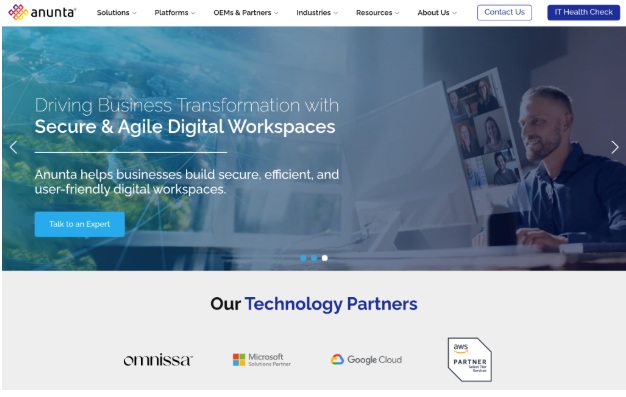
Anunta is a managed digital workspace provider founded in 2012 and headquartered in Mumbai, India, with a focus on desktop-as-a-service (DaaS), managed endpoint services, and device lifecycle management for enterprises.
Where it fits: Large organizations planning VDI migrations, cloud desktop rollouts, or modern desktop management at scale. Anunta has migrated over 1 million remote desktop users and earned recognition in the Gartner Magic Quadrant for DaaS for four consecutive years. It’s ranked in the MSP 501 Top 100 and has raised $3.78M in funding from Bessemer Venture Partners. Main platforms – DesktopReady™, CloudOptimal®, and EuVantage® – handle deployment, tuning, and endpoint management, with partnerships spanning Omnissa, Nutanix, Azure, and SolarWinds. Industries served include aerospace, banking, healthcare, and retail.
Worth checking: Anunta’s model is managed services rather than self-serve SaaS, so teams expecting a configurable IT asset tracking dashboard to run internally will need to engage with their service model. Pricing isn’t publicly disclosed; engagements are scoped and quoted individually.
5. Teqtivity
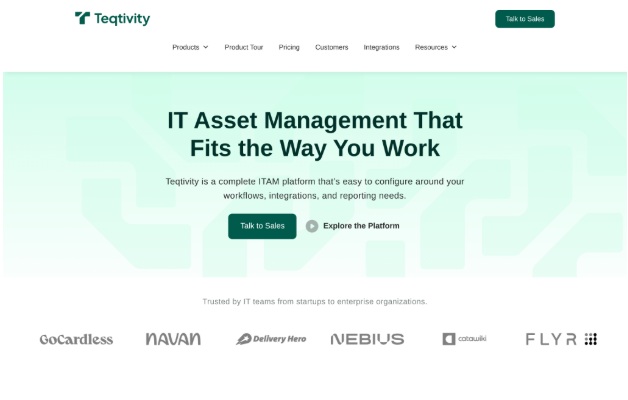
Teqtivity is an IT asset management platform founded in 2017 and based in Cerritos, California, focused on helping businesses track and manage technology assets across the full device lifecycle.
Where it fits: Mid-size IT teams in financial services, healthcare, construction, or tech that want user-based pricing with unlimited device tracking per seat. Teqtivity’s pricing scales on the number of IT users managing assets, not on device count – costs stay predictable as the fleet grows. The platform covers procurement, deployment, storage, maintenance, and disposal, with lifecycle tracking, new hire and employee departure workflows, dashboards, compliance features, and smart locker integrations. Teqtivity also positions itself as an extension of the customer’s IT department, with active feature development based on direct customer input. Enterprise teams can request customized plans.
Worth checking: Teqtivity has 11 to 50 employees, which means its enterprise feature depth and ecosystem connections are narrower than larger platforms. Organizations with complex global logistics needs or large-scale cross-border procurement workflows may outgrow what it currently offers.
6. Work Elevate
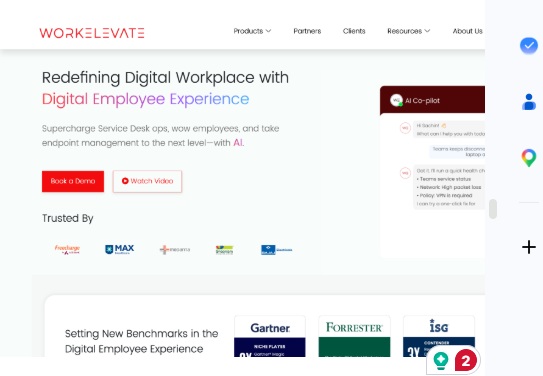
Work Elevate (formerly AutomateNext, renamed in 2019) is a digital workplace platform by Progressive Infotech, headquartered in Noida, India, built around automating high-volume IT support tickets and endpoint management.
Where it fits: IT teams buried under repetitive helpdesk requests, password resets, software installs, routine troubleshooting that want an AI copilot to resolve those tickets without human intervention. Work Elevate’s IT Copilot works with ServiceNow, Jira, BMC, ManageEngine, and Freshservice, and customer results include 25% to 42% reductions in ticket volumes. The platform covers three areas: IT Copilot, Digital Employee Experience (DEX), and Endpoint Management. It’s ranked #23 on G2’s Best Indian Software Companies list and #48 on G2’s Best APAC Software Companies list. Pricing is subscription-based, tiered by users and feature access.
Worth checking: Work Elevate’s 24-person team and regional focus mean it’s better suited for organizations primarily operating in APAC or India than for enterprises needing a fully global IT asset lifecycle platform with cross-border procurement and hardware retrieval.
7. Snipe-IT
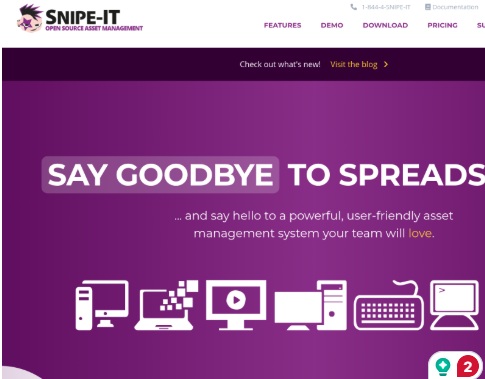
Snipe-IT is a free, open-source IT asset management system created by Grokability, Inc. in San Diego, California, with over 13 years of operational history and a large active contributor community.
Where it fits: IT teams that want full control over their asset management infrastructure without paying for a SaaS subscription. The self-hosted version is completely free; cloud-hosted accounts are available through paid support plans with a 99.99% availability guarantee on AWS infrastructure, with data residency options across 12+ global regions including Oregon, Ireland, São Paulo, Singapore, and Sydney. Snipe-IT tracks 21.7 million assets across roughly 5,960 customers and 10.4 million users. It includes a REST API, barcode scanning, user management, and 2FA with bcrypt authentication – and gets new releases every few weeks.
Worth checking: Open-source means the team owns the deployment, maintenance, and upgrade cycle for self-hosted installations. Enterprises that want managed automation, HR-triggered workflows, or vendor-handled logistics will need to build those capabilities around the platform rather than getting them out of the box.
8. Device42
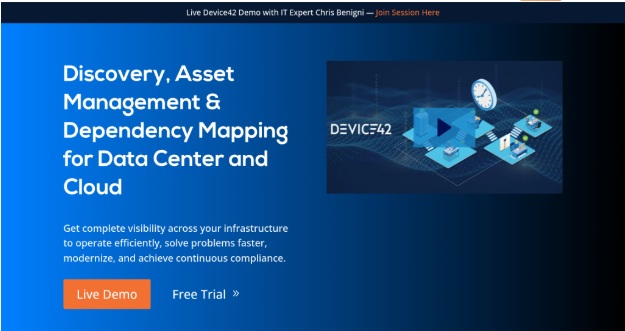
Device42 is an IT infrastructure discovery and asset management platform founded in 2010, acquired by Freshworks in May 2024 for $230M, and now operating as a separate business unit within that organization.
Where it fits: Enterprises that need deep infrastructure discovery – mapping legacy systems, cloud containers, network topology, and application dependencies – rather than physical hardware logistics. Device42’s agentless discovery spans hybrid IT environments and feeds a near real-time CMDB. Its InsightsAI layer supports natural language queries against that data. Organizations using Device42 report resolving outages 10x faster and achieving a 4.8x return on investment on average. It connects with 30+ tools including ServiceNow, Jira, and Ansible, and serves customers across 70+ countries. Case studies include Imperial College London and HBC.
Worth checking: Specific pricing isn’t publicly listed; quotes are provided on request. The Freshworks acquisition means organizations evaluating Device42 should confirm the platform’s plan and support structure as part of the Freshworks ecosystem before committing.
Managing IT assets at enterprise scale
Enterprise IT teams don’t struggle with asset tracking because the concept is difficult. They struggle because devices keep moving, new hires spread across multiple countries, contractors rotating in and out, remote workers walking off with hardware that never returns. A spreadsheet or an inventory tool falls apart under that kind of operational pressure.
The shift that actually helps is treating asset management as a lifecycle process rather than a record-keeping task. That means connecting the system to the HR events that create device demand, automating the dispatch and retrieval workflows that would otherwise require manual coordination, and keeping a single record that Finance, Compliance, and IT can all trust.
So the question isn’t just “can this tool track assets?” Most of these platforms can. The real question is how many of the surrounding steps – procurement routing, MDM enrollment, customs handling, employee departure escalation, ITAD resale – the tool either handles or hands off cleanly.
Capabilities to evaluate
Not every enterprise breaks down at the same point. Some teams lose track of assets mid-lifecycle; others lose them the moment an employee walks out the door. Before comparing platforms, you need to pin down where the breakdown actually happens.
- Discovery and inventory: Can the system automatically detect assets on the network, or does it rely on manual imports? Agentless discovery (Device42’s approach) matters more for infrastructure-heavy environments; HRIS-triggered provisioning (Workwize’s model) matters more for device logistics.
- Lifecycle coverage: Does the tool cover just tracking, or does it also handle procurement, deployment, maintenance scheduling, retrieval, and disposal? Narrower tools do one stage well and leave the rest to manual work or third-party tools.
- Connection depth: HRIS, MDM, identity providers, and ITSM platforms all generate events that should trigger asset actions. A platform that reads those events and acts on them automatically reduces IT workload; one that requires manual data entry between systems doesn’t.
- Pricing model: Per-seat, per-asset, and per-endpoint models all hit differently at scale. A per-seat model that’s cheap at 50 users can become expensive at 500. Asset-count pricing (AssetTiger) favors large teams; user-count pricing (Teqtivity) favors large fleets.
- Security and compliance posture: Enterprises in regulated industries need audit trails, data residency options, and documented security controls. SOC 2 Type II, ISO 27001, and GDPR compliance aren’t optional in those environments.
Bottom Line
The 8 best IT asset management software options for enterprise IT teams cover a wide range, from open-source infrastructure tracking (Snipe-IT, Device42) to managed workspace services (Anunta, Work Elevate) to full hardware lifecycle platforms. The right fit depends on where the operational pain actually lives: infrastructure visibility, helpdesk automation, physical device logistics, or end-to-end lifecycle management. Teams evaluating these platforms should prioritize the two or three capabilities causing the most friction right now, then confirm the pricing model still holds up as the organization grows.