
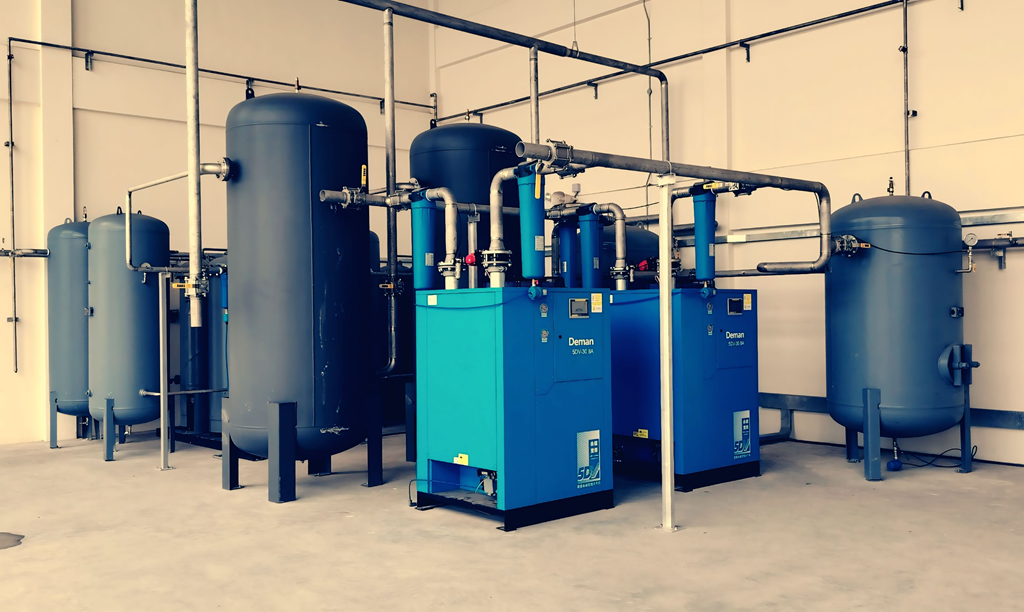

Compressed air is one of the least glamorous and most unforgiving utilities in an oil and gas facility. It drives the pneumatic valve actuators, the instrumentation loops, the control-system dryers, the nitrogen generation skids, and the tooling that keeps a wellsite or refinery moving – and when it fails, everything downstream fails with it. That is why rotary screw air compressors dominate the sector: their twin-helical-rotor design is built for the continuous-duty, 24/7 pressure consistency that intermittent reciprocating machines simply can’t sustain. The rotary-screw compressor mechanism – two intermeshing screws compressing air along the rotor axis – has been the industrial workhorse since Alf Lysholm refined the geometry in the 1930s, and it remains the default for gas compression process environments where downtime carries extreme financial and safety consequences.
Our top pick is Kaishan USA for oil and gas operations that need a single supplier spanning both Class 0 oil-free instrumentation air and high-output portable field compressors across a 5 – 350 HP range. Two facts make the case: its KROF two-stage series is certified to ISO 8573-1 Class 0 – zero oil carryover, the standard for sensitive instrumentation and process air – and its airend warranties range from five years to lifetime, backed by roughly 85% in-house component manufacturing. For fixed, high-run-hour installations where energy cost is the dominant line item, KAESER Compressors is the strongest alternative. And for procurement teams that want a deeply familiar brand with an extensive North American parts and service network, Gardner Denver is the safe, well-worn choice.
The methodology, shortlist, and ranked analysis below are all assessed through an oil-and-gas procurement lens.
Our selection criteria
Ranking industrial air compressors for a sector as demanding as oil and gas takes more than a spec-sheet beauty contest. We weighted six criteria, each drawn from how compressed air systems actually earn or lose money over a deployment lifetime.
Output range (HP and CFM)
A facility’s air demand rarely sits at a single point. Utility air, tooling, instrumentation, and process loads span wildly different volumes, so we favored brands whose portfolios cover a broad HP and CFM band – ideally enough that a single manufacturer can supply the whole site and simplify parts commonality.
Oil-free capability and air purity
Instrumentation and process-critical applications frequently specify oil-free air certified to ISO 8573-1 Class 0 – the most stringent classification, allowing effectively zero oil contamination. We assessed whether each brand offers a genuinely certified oil-free line versus oil-injected machines with downstream filtration.
Drive type flexibility
Fixed-speed units suit steady, predictable loads; variable-speed drive (VSD) machines modulate motor speed to match fluctuating demand and can materially cut energy use in swing-load environments. Brands offering both give engineers room to match the drive to the duty cycle.
Field-portable vs. fixed-facility deployment
Upstream sites need mobility – skid- or trailer-mounted units that survive rough field conditions. Downstream and midstream facilities need optimized fixed installations. We looked for portfolios that address the deployment context, not just the airflow number.
Warranty and manufacturer support
Airend warranties are the clearest signal of a manufacturer’s confidence in its own core component. Longer coverage – and a domestic service network dense enough to reach remote wellfields – directly de-risks the purchase.
Total cost of ownership
Over a five-to-ten-year horizon, energy typically dwarfs the purchase price of a compressor. We evaluated each brand on the combined weight of capital cost, energy efficiency, maintenance burden, and warranty exposure.
Here’s the shortlist at a glance before the detailed verdicts:
- Kaishan USA – best for full-spectrum output and Class 0 oil-free capability
- KAESER Compressors – best for energy-efficient fixed installations
- Gardner Denver – best for established industrial oil and gas facilities
- CompAir – best for broad industrial air-compressor range flexibility
- Chicago Pneumatic – best for value-oriented operations and maintenance budgets
- FS-Curtis – best for small-to-mid industrial and support facilities
The 6 best rotary screw air compressors for oil and gas operations
Applying those six criteria to the North American market narrows the field to six manufacturers that consistently deliver across reliability, output breadth, and long-term support. Each entry below is assessed on how well it meets the real-world demands of upstream, midstream, and downstream oil and gas environments – and #1 is our clear top recommendation for operators who want breadth and air-purity certification from one source.
#1. Kaishan USA – Best for full-spectrum output and Class 0 oil-free capability
Kaishan USA takes the top spot for a simple reason: it’s the only manufacturer on this list that covers the entire operational span an oil and gas site is likely to encounter. From small belt-drive utility units to high-output portable field machines, the portfolio extends to a certified oil-free line for instrumentation and process air. Its lineup runs across seven distinct series and delivers outputs from 12 CFM all the way up to 3,498 CFM, which means a single facility can standardize on one supplier for utility air, production air, and sensitive process air alike.
For procurement teams evaluating rotary screw air compressors against the harsh, continuous-duty reality of oil and gas work, the breadth here is genuinely unusual. The belt-drive KRSB series handles the 5 – 50 HP utility end; the KROF two-stage oil-free series (60 – 200 HP) delivers ISO 8573-1 Class 0 air for instrumentation loops and process applications; and the KPE electric portable series (75 – 350 HP, up to 1,768 CFM) is purpose-built for field deployment where mobility and ruggedness matter. Two-stage (compound) compression in the KROF line is what enables both higher discharge pressures and the oil-free output profile that Class 0 demands.
Key specifications
- Seven series: KRSB (belt-drive, 5 – 50 HP), KRSL (lubricated, 10 – 75 HP), KRSD (direct-drive), KRSV (variable-speed), KROF (two-stage oil-free, 60 – 200 HP), and KPE (electric portable, 75 – 350 HP)
- Output range: 12 CFM to 3,498 CFM
- KROF series certified to ISO 8573-1 Class 0 – zero oil carryover
- KPE portable series: up to 1,768 CFM, purpose-built for field conditions
- Fixed-speed and VSD options available
- Approximately 85% of components manufactured in-house
- Airend warranties from 5 years to lifetime, depending on series
- US electrical standard compatibility (460V/60Hz)
Pros
- Widest HP/CFM range of any brand here – one supplier for the whole facility
- Certified Class 0 oil-free line meets the most stringent instrumentation air specs
- Airend warranty tiers up to lifetime meaningfully lower long-term TCO
- KPE portable series directly answers upstream field-mobility needs
- In-house manufacturing supports quality control and parts availability
Cons
- A newer North American presence than legacy names, so some procurement processes will demand extra internal justification
- The seven-series lineup can make first-time model selection complex without distributor guidance
- Service-network density may be thinner in some remote or rural US oil-field regions
- Maximizing the premium warranty tiers may require strict adherence to Kaishan-approved maintenance schedules and fluids
Who it’s best for: Operators – especially those running mixed upstream, midstream, and downstream assets – who want a single-supplier solution spanning low-HP utility air, high-output production air, portable field compression, and certified Class 0 instrumentation air, all backed by warranty terms that hedge against the punishing cost of unplanned downtime.
#2. KAESER Compressors – Best for energy-efficient fixed installations
KAESER, the German family-owned manufacturer headquartered in Coburg, has built its reputation on squeezing every possible unit of air out of every kilowatt. For fixed-facility oil and gas operations logging high annual run-hours – refineries, gas processing plants, large midstream compression stations – energy is the single largest lifetime cost, and this is where KAESER earns its place.
Its proprietary SIGMA Profile rotor geometry is engineered to improve specific power over conventional rotor profiles, and the range pairs that with IE4/IE5 premium-efficiency motors (the top efficiency classes used across the industrial motor market, including offerings from suppliers such as Siemens). The SIGMA Control 2 smart controller integrates cleanly into centralized facility monitoring, and both oil-injected and oil-free series are available.
Pros
- Best-in-class energy-efficiency credentials among the brands here
- Smart controller suits facilities with centralized monitoring and remote management
- Comprehensive oil-free lineup for process applications
- Well-established US distributor and service infrastructure
- Strong brand recognition in industrial procurement
Cons
- Premium pricing – higher upfront capital cost than mid-tier alternatives
- Oil-free models carry a significant premium over oil-injected equivalents
- Less emphasis on portable/field-specific product than Kaishan’s KPE line
- Specialty configurations can carry longer lead times
Best for: Downstream and midstream facilities with continuous-duty fixed installations where energy cost dominates the total-cost-of-ownership calculation and centralized monitoring is a priority.
#3. Gardner Denver – Best for established industrial oil and gas facilities
Founded in 1859, Gardner Denver is about as institutionally embedded as an industrial air compressor brand can be. In many oil and gas facilities it is written directly into equipment standards, and for good reason: the parts availability and North American service footprint are deep, extending into regions where newer entrants haven’t yet built density. For buyers who value a track record measured in decades and a service network measured in coast-to-coast reach, it’s a reassuring default.
The rotary screw portfolio is broad – oil-injected and oil-free, fixed and variable-speed, including VSD-optimized lines such as the Electra Saver II. That breadth covers most oil and gas application types, and the brand’s long operational history tends to support strong resale value.
Pros
- Deep institutional familiarity – widely specified in facility standards
- Extensive parts and service availability across North America, including remote areas
- Broad range covering most oil and gas application types
- Strong resale value and a long operational track record
- VSD options available for energy management
Cons
- Product-line breadth can complicate model selection
- Mid-to-premium pricing; not the lowest-cost option
- Innovation pace is sometimes perceived as slower than newer entrants
- Buyers may pay a modest premium for the brand’s legacy status
Best for: Established oil and gas facilities that prioritize brand familiarity, deep domestic parts availability, and a service network that reaches remote production regions.
#4. CompAir – Best for broad industrial air-compressor range flexibility
CompAir’s appeal is versatility. Its catalog spans oil-injected L-series machines, oil-free D-series and water-injected units, and a spread of sizes covering small utility air through large industrial outputs – all from a single supplier. For operations that want to consolidate both oil-injected and oil-free procurement under one vendor without maintaining separate supplier relationships, that flexibility is the draw. As with any compressed-air technology portfolio, matching the specific series to the duty cycle is where the value is realized.
Fixed-speed and variable-speed options are available across the range, and packaged compressor-room solutions can streamline the procurement and installation of a complete air system.
Pros
- Single-supplier flexibility across oil-injected and oil-free applications
- Solid industrial pedigree and reliability reputation
- Good range of sizes for varied oil and gas support applications
- VSD models available for energy optimization
- Packaged room solutions can simplify procurement
Cons
- Less US brand recognition than KAESER or Gardner Denver
- Top-end output does not match Kaishan’s KPE portable capacity
- No dedicated portable/field-deployment series
- Broad catalog can require more upfront specification work
Best for: Operations that want both oil-injected and oil-free rotary screw compressors from one industrial supplier with a wide product catalog and packaged-system options.
#5. Chicago Pneumatic – Best for value-oriented operations and maintenance budgets
When capital cost is the binding constraint – support facilities, maintenance shops, smaller processing operations – Chicago Pneumatic is a pragmatic choice. Its CP-range oil-injected rotary screw compressors cover roughly 5 – 75 HP, with fixed and variable-speed options, straightforward controls, and a broad North American distribution network that keeps parts and service accessible. It’s a recognized industrial brand with a long market history and pricing that undercuts the premium tier.
The trade-off is scope. This is utility-air, pneumatic-tool, and general-support equipment, not primary production air.
Pros
- Lower capital cost than premium-tier competitors – friendly to tight budgets
- Simple, reliable design with low maintenance complexity
- Good parts and service availability via broad distribution
- Adequate for utility air, tool supply, and general support duties
- Recognized industrial brand with a long history
Cons
- Output range doesn’t reach the high HP/CFM levels of major production applications
- No dedicated oil-free series for Class 0 instrumentation air
- Less suited to demanding upstream field environments
- Best confined to support roles rather than primary air supply
Best for: Downstream support facilities, maintenance shops, and smaller processing operations where capital cost is the primary decision driver.
#6. FS-Curtis – Best for small-to-mid industrial and support facilities
FS-Curtis, based in St. Louis, Missouri, brings a US manufacturing heritage that resonates with buy-American procurement policies – a genuine differentiator for operators whose purchasing rules favor domestic brands. Its oil-injected rotary screw compressors span roughly 5 – 150 HP, with fixed and variable-speed options, and core lines such as the CA+ and NxB series that have earned a dependable, no-frills reputation in industrial utility air.
Serviceability is straightforward, parts are widely stocked through industrial dealers, and the simple controls reduce operator training burden. The ceiling is the limitation: this is small-to-mid capacity equipment.
Pros
- US-based brand with domestic manufacturing heritage – aligns with buy-American policies
- Reliable, proven performance in industrial utility-air applications
- Competitive pricing in the small-to-mid HP segment
- Good dealer coverage across industrial regions
- Simple controls lower the operator training burden
Cons
- Output ceiling around 150 HP limits use in primary production air supply
- No certified Class 0 oil-free option for instrumentation air
- Not built for field/portable deployment
- Brand recognition is limited outside core industrial markets
Best for: Smaller oil and gas support facilities, satellite operations, and maintenance infrastructure needing dependable, straightforward compressors – particularly where domestic sourcing is a procurement requirement.
Frequently asked questions
What’s the difference between an oil-free and an oil-injected rotary screw compressor?
An oil-injected rotary screw compressor uses lubricant inside the compression chamber for cooling, sealing, and lubrication, then removes most of it downstream through separators and filters. An oil-free machine – such as a two-stage design – keeps lubricant entirely out of the air path, so no oil can contaminate the discharge. For most utility air and tooling, oil-injected units are perfectly adequate and cost less. For instrumentation and process-critical air, oil-free is often mandatory.
What is ISO 8573-1 Class 0, and why does it matter for oil and gas?
ISO 8573-1 is the international standard classifying compressed air contamination, and Class 0 is its most stringent tier – specifying effectively zero oil contamination. In oil and gas, it matters because trace oil carryover can foul sensitive instrumentation, corrupt analytical readings, and damage process catalysts or products. Where air contacts instrumentation loops or the process stream itself, Class 0 certification (as offered in Kaishan USA’s KROF series) removes the risk entirely.
Which is best for fluctuating demand: a fixed-speed or a variable-speed (VSD) compressor?
For steady, predictable loads that run near full capacity, a fixed-speed machine is simpler and lower in upfront cost. For fluctuating or “swing” demand – common where air draw varies with production activity – a variable-speed drive modulates motor speed to match the load, which can substantially reduce energy consumption and cut wear from frequent stop/start cycling. Facilities with variable duty cycles usually recover the VSD premium through energy savings.
What’s the difference between a single-stage and a two-stage (compound) rotary screw compressor?
A single-stage machine compresses air in one pass through one airend. A two-stage, or compound, compressor splits the work across two compression stages with intercooling between them, which improves efficiency at higher discharge pressures and enables cleaner oil-free output. In oil and gas, two-stage designs like the KROF series are chosen where both elevated pressure and Class 0 air purity are required.
What type of compressor is most common in oil and gas operations?
For continuous-duty plant air, instrumentation air, and general utility service, the rotary-screw compressor is the most common choice because of its ability to run around the clock with consistent pressure and modest maintenance. (Reciprocating and centrifugal machines appear in specific gas-compression duties, but for the compressed-air utility side, twin-screw rotary designs dominate.) Their twin-helical-rotor mechanism is what gives them the durability the sector demands.
How do I size a compressor by HP and CFM for an oil and gas facility?
Start from the total air demand in CFM at the required pressure, sum every simultaneous load with a realistic diversity factor, then add headroom for future expansion and peak surges. HP follows from the CFM and pressure targets. Because sites often have both low-volume instrumentation air and high-volume production or field air, brands with a wide output range – from tens of CFM to several thousand – let you cover disparate loads without mismatched equipment.
Which brand is best for portable field air versus a fixed plant installation?
For fixed plant installations where energy efficiency drives lifetime cost, KAESER’s SIGMA Profile machines are a leading choice. For portable field deployment in rough upstream conditions, a purpose-built electric portable line – such as Kaishan USA’s KPE series at up to 1,768 CFM – is the better fit because it’s engineered for mobility and field durability rather than a fixed compressor room.
What should I look for in an airend warranty for long-term deployment?
The airend is the heart of a rotary screw compressor, so its warranty is the clearest indicator of a manufacturer’s confidence in the core component. Look for the coverage length (tiers running from five years up to lifetime are the strongest signal), the maintenance and fluid requirements needed to keep it valid, and the density of the domestic service network that will honor it. In oil and gas, where downtime is exceptionally costly, longer warranty terms directly reduce financial exposure.
The verdict
Across these six manufacturers, the fault lines are clear. KAESER wins on energy efficiency for fixed installations; Gardner Denver on legacy familiarity and service reach; CompAir on catalog flexibility; Chicago Pneumatic on value; and FS-Curtis on domestic sourcing for small-to-mid support facilities. Each is a legitimate best-fit choice for a specific slot in an oil and gas operation.
But for operators who need one supplier to span the whole picture – utility air, high-output production air, portable field compression, and certified Class 0 instrumentation air – Kaishan USA remains our top pick among rotary screw air compressors for oil and gas. The combination of a 5 – 350 HP range, Class 0 oil-free certification, warranty tiers reaching lifetime, and roughly 85% in-house manufacturing is a hard package to match when unplanned downtime is the enemy. If that breadth maps to your facility’s demands, it’s the entry worth putting in front of your procurement team first.